Network and IT for distributed plants that run reliably and show it.
Solar arrays, biogas plants and heat supply run across multiple sites, often with no one on hand when something fails. NDVDL plans and builds network, segmentation and monitoring for energy suppliers, plant operators and municipal utilities in Vienna, Lower Austria and Slovakia.
- A direct line to your engineer
- Operation including hardware replacement
- Planned and built for your business
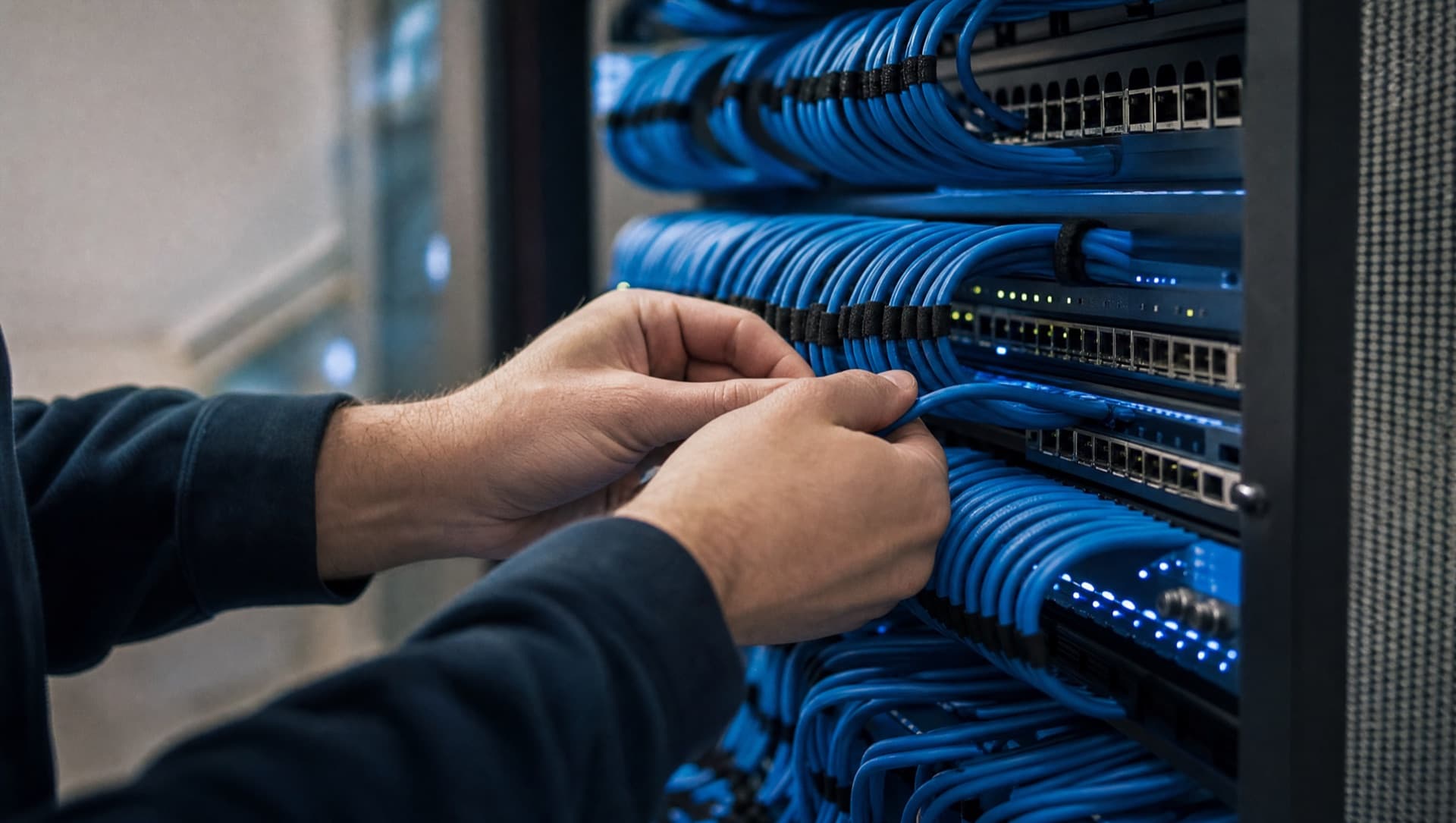
Why does an energy plant need a separate network for control systems and the office?
An energy plant needs a separate network for control systems and the office because a problem on the office network – an infected workstation, for instance – would otherwise have a direct path to plant control. NDVDL sets up control systems and the office network as separate segments, so an incident in one area doesn't spread unchecked into the other. That's paired with controlled remote access for operators and manufacturers, monitoring with alerting for failures, and connectivity for sites without a fixed line. The result is a plant that stays monitorable and maintainable without leaving control systems and office IT connected unprotected.
What actually goes wrong for energy suppliers and plant operators
Not theory – the situations that come up with distributed plants.
Control systems and the office network share one line
Control systems, metering equipment and office PCs often run on the same network with no separation between them. A problem on the office network can then spread unchecked to plant control.
A failure goes unnoticed until yield is already missing
Without monitoring and alerting, a plant failure often only comes to light when the monthly report shows a drop in yield. By then, the lost output is already gone.
Sites without a fixed line are hard to reach
Some plants sit at locations with no fixed internet connection available. Without a working link, remote access, monitoring and data transfer at that site stay unreliable or fail entirely.
Unmanned sites are hard to secure against access and tampering
Substations, open solar arrays and biogas plants often sit off the beaten path and go unwatched for most of the day. Without access control and video surveillance, unauthorised entry or tampering with the plant often only comes to light much later.
IT infrastructure for plants and sites
Six building blocks that can be implemented individually or together, matched to distributed plants and operations without constant on-site presence.
Separating control systems from the office network
Control systems, metering equipment and office IT are set up as separate network segments with controlled crossover points between them. That keeps an incident in one area contained instead of spreading to plant control.
Remote access to plants across multiple sites
Operators get a central, secured point of access to distributed plants instead of maintaining a separate solution per site. Access is scoped by user and by plant.
Connectivity for sites without a fixed line
For plant sites without an available fixed connection, a suitable alternative is planned, such as a cellular or wireless link. The goal is a connection that makes remote access and monitoring possible at that site in the first place.
Controlled integration of manufacturer remote maintenance access
Remote maintenance access for equipment manufacturers is set up and scoped rather than opened broadly. That keeps manufacturer maintenance possible without the access reaching beyond it.
Monitoring and alerting for plant failures
Plants are monitored and actively report failures or deviations instead of these only surfacing at the next review. That shortens the time between a failure and the response to it.
Access control, video surveillance and metering data integration
Unmanned sites are equipped with access control and video surveillance matched to the specific plant. Metering data is captured and passed to existing billing systems rather than replacing them.
Related services in detail
What projects for energy suppliers and plant operators tend to look like
Three project shapes that come up regularly in practice.
Separating control systems and the office network after the fact
An operator discovers that plant control and office IT are running on the same network and wants to separate them without interrupting operations. NDVDL plans the segmentation, sets up controlled crossover points and integrates existing manufacturer remote maintenance access accordingly.
Multiple plant sites need central monitoring
An operator with several solar or biogas plants across different sites wants to stop discovering failures only at the next on-site check. NDVDL sets up remote access and monitoring with alerting, including connectivity for sites without a fixed line.
An unmanned site gets access control and cameras
An operator wants to secure a remote substation or open solar array against unauthorised access. NDVDL sets up access control and video surveillance and connects the site to central monitoring.
Plan network, segmentation or monitoring for your plants
Outline your situation briefly – you'll hear back by phone or email.
Rather talk it through? Call us — you reach someone who knows the technology.
+43 800 007075Questions about IT for energy suppliers and plant operators
What operators want to know before a project.
Further reading
Plan network, segmentation or monitoring for your plants
Tell us what is on your plate. We get back to you, listen, and say honestly what makes sense and what does not.